High Medical Fees, Limited Affordability and Counselling Challenges Raise Questions About Access to Medical Education
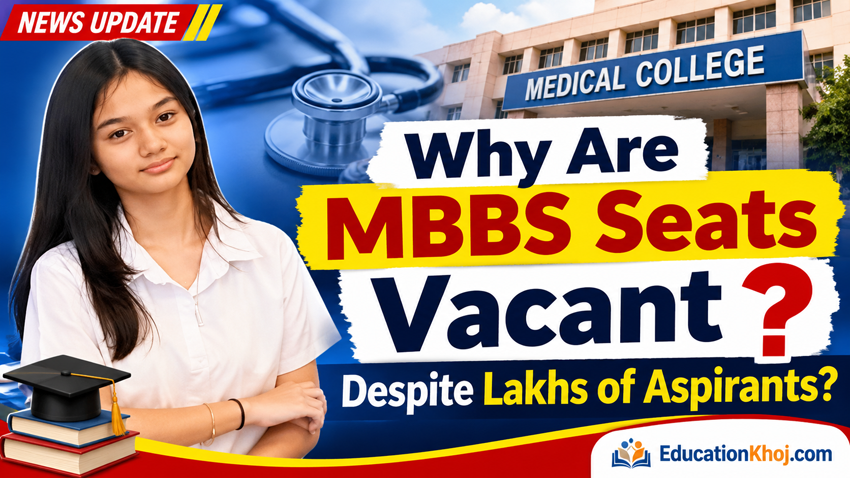
There is a strange paradox in the Indian medical education system. Each year, many lakhs of students appear for the National Eligibility cum Entrance Test (NEET-UG) to gain admission to an MBBS course. Some students prepare for the examination for over a decade. Their families invest a lot of money and emotional energy to fulfill their wish of being doctors. Nevertheless, even after many rounds of counselling, many seats in MBBS courses are still vacant.
This situation has once again highlighted the question of accessibility and affordability of medical education. As per the report on the 2026 admission cycle, many MBBS seats have remained vacant despite the additional counselling rounds conducted by the Medical Counselling Committee (MCC).
More Than 400 Seats Remain Vacant Even After Special Counselling
The Medical Counselling Committee had a Special Stray Vacancy Round which was aimed at filling MBBS seats which were left vacant by the normal counseling procedure.
From reports, the total number of vacant MBBS seats was 948, but of those, only 537 were allotted while 411 seats were still left vacant despite this special round. This is especially worrisome considering the fact that India has a huge number of candidates who have qualified in NEET and wish to pursue medical education.
High Fees: A Major Reason Behind Vacant Seats
One of the primary factors cited for the cause of these gaps is the expensive nature of the medical education, especially at the private medical colleges and deemed universities.
As per reports in the media, annual tuition fees at various private and deemed medical colleges have gone up to Rs. 23 lakh to Rs. 35 lakh. Once extra expenses like those for hostels, messes, etc., are taken into account, the financial burden rises sharply.
For most middle-class parents, getting the child through an MBBS course at these places is not affordable at all. Even students who are able to get NEET qualifying marks may be compelled to reject offers of admission due to the financial burden.
Fee concessions have also been reported to have been given by some private medical colleges to attract students.
Tamil Nadu, Puducherry and Karnataka Among the Affected Regions
However, this is not an isolated case in a few institutions only. According to the report, almost 2,000 MBBS seats have been left unoccupied in India after multiple rounds of counseling done by both the central and state governments.
Tamil Nadu and Puducherry became two worst hit states with 824 seats unoccupied in 14 deemed universities according to the last round of centralized counseling process. Karnataka also had 191 MBBS seats unoccupied despite multiple rounds of counseling.
Government seats quota was also found to be vacant but mostly the unoccupied seats have been noticed in the private medical institutions.
Should the Government Reconsider the Admission and Fee Structure?
The increasing vacancies have led the medical colleges and the state government to approach NMC for obtaining permissions for extra counselling rounds and for revisiting the criteria for qualification.
But just cutting the qualifying percentile for NEET would fail to solve the root cause of the problem. If the fees charged by the medical colleges are unaffordable for the students, then just cutting down the qualifying percentage will not motivate the students to take admission.
A better strategy could be:
• Checking the fees charged by private medical colleges and deemed universities.
• More access to education loan and scholarships.
• Transparency in tuition fees and other extra charges.
• Looking for any possible additional counselling where it is feasible.
• Making the medical education affordable for deserving students from middle and economically weaker families.
The aim should be to make effective use of the available medical education infrastructure without making any compromise on admission standards and quality of medical education.
A Question of Opportunity, Not Just Seats
An essential question arises from the situation. Why should there be vacant seats for medical students when thousands of students dream of becoming doctors and take the toughest examination in India? India requires more doctors and infrastructure. More colleges and seats of MBBS are surely required, but if the cost factor is not tackled properly, then the whole effort will not bear fruit.
Just because there is an underprivileged but eligible NEET-qualified student who cannot pay for the fees does not mean that an MBBS seat should go unoccupied.
In this context, there needs to be a middle ground between the government, NMC, medical college, and the counseling body. An increase in accessibility and affordability in medical education can definitely prove helpful.
However, the true test of success of increasing the scope of medical education cannot only be seen in the number of MBBS seats created, but also in the number of deserving candidates who can occupy them.