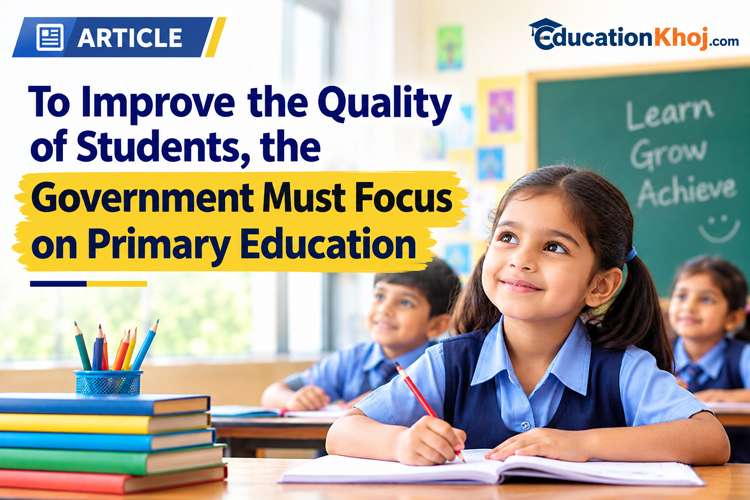
The overall quality of the education system in a particular country can be gauged from how well the country's primary education system is doing. These initial years of education become the base for further development of knowledge and personality of a child. If the basics of learning are inculcated in the primary years of a child's education then there are better chances of success in his/her secondary, higher, and finally professional education.
Therefore, if the government intends to bring improvement in the overall quality of the students studying in government schools, it needs to focus on improving the standard of primary education. Improvement in the standards of primary schools will not only mean building of classrooms and provision of books but also teachers and many other aspects.
Why Primary Education Is So Important
Primary education is where children gain the basic skills of reading, writing, mathematics, communication, and logic. The above skills become the foundation for all other things they learn in the future.
For instance, when a child advances into the higher grades but cannot read and write properly, cannot comprehend a paragraph, do simple math, and communicate his ideas effectively, he may find it hard to learn other complex subjects.
Thus, learning improvement at the primary level will help to avoid further educational complications in the future.
Strong Foundations Create Better Students
It will be difficult for a child to have a bright future in education without a sound educational foundation. Hence, it becomes essential that the government focuses on the fundamentals of literacy and numeracy during the early stages of education.
These fundamentals include the ability to read well, write clearly, do basic calculations, express themselves well, and have curiosity about the environment.
But primary education must not turn into a competition in finishing textbooks. The young ones are capable of learning things through an interesting, interactive, and real-world approach.
The Teacher Is the Most Important Resource
Any educational reform program cannot succeed without good teachers. The government must see to it that the government primary schools are well supplied with teachers who are both qualified and motivated.
The teachers who teach young children must undergo special training since teaching primary children needs a different method compared to teaching older children. The young ones require a lot of patience, motivation, repetition, activity-based lessons, and individual attention.
Teacher training programs must thus concentrate on teaching methods rather than just theoretical information.
Also, teachers must be supplied with proper teaching materials and not be assigned too many tasks other than teaching the children.
Early Identification of Learning Gaps
The benefit of considering primary education is that any learning difficulties can be found early.
When the child is having difficulty in reading, writing, comprehending numbers, or communication, the school needs to detect the problem early and offer further assistance. Thus, remedial and personalized education will stop the small gap in learning into a big one.
Assessment will be done, therefore, not only to give marks but also to know what the child knows.
Improve the Learning Environment in Government Primary Schools
A good primary school should have a safe, clean, attractive and children-friendly environment.
The investment by the government should guarantee that children get access to:
• Safe and properly maintained classroom
• Pure drinking water
• Adequate toilets
• Electricity
• Libraries and reading corners
• Learning-teaching aids
• Safe play areas
• Science equipment
• Activity aids
• Proper digital equipment
However, the infrastructural development should not be taken in itself.
Nutrition and Education Are Connected
Children do not learn when they are hungry or malnourished. This means that there is a close relationship between school nutrition and primary education.
Provision of meals at school as well as other forms of nutrition will help in ensuring that the children are healthy and attend school consistently. A healthy child can be able to focus and participate in class lessons.
This shows that improvement in primary education goes beyond provision of books and classrooms.
Parents and Communities Must Be Involved
Learning is not confined to the four walls of a school room. It is essential for parents and community members to play a part in helping children learn.
The parents must be encouraged to form good learning practices at home that include reading with the child, asking about their studies, answering questions, and practising certain skills.
It is important to note that there is no need for parents to be highly educated to help their children learn.
Government schools can also engage with the local communities in order to raise attendance rates.
Technology Should Support, Not Replace, Teachers
Technology has opened new doors in learning at the primary level of schools. Educational videos, educational applications, digital libraries, and other such technological methods can help make complex ideas understandable.
But still, technology needs to be used in moderation. Giving tablets or smart boards will not help improve education by itself. Teachers require training in technology, while the children need good educational content.
The teacher is the main actor in learning, while technology is simply a helper.
Moving Beyond Marks at the Primary Level
Another significant thing that needs to be done is to lessen the obsession with marks at a very young age. Primary schooling should concentrate more on comprehension than mere memorization.
Children need to be taught the art of asking questions, experimenting, communicating, and problem solving. Early exposure to examinations will kill the curiosity of children and make them afraid of learning.
The ultimate goal would be to produce confident learners.
A Long-Term Investment in India's Future
The investment made in primary education does not yield immediate results, but they are quite significant in the long run. Students who acquire good fundamental skills will find it easier to learn more advanced subjects, continue their education at secondary level and even in universities or technical institutes, and become productive members of the society.
Thus, if the government is serious about the quality of education in government schools, then it should pay more attention to primary education, and not wait until the students go to secondary schools.
Conclusion
The standard of future students will largely be determined by the standard of their primary education. Primary education is the backbone of the whole educational system, and any deficiency in this area can haunt a student for several years.
What the government needs to do is concentrate on good teachers, basic literacy and numeracy skills, a friendly school environment, proper nutrition, regular assessment of students' progress, remedial classes, involvement of parents, and appropriate use of technology.
Above all, schools have to provide an environment where children feel like learning and not being afraid of exams.
For better students tomorrow, we need to establish better schools today. With strong basics, come confident students who make a confident society.