Education News | 10 Nov, 2026
New Delhi: There is a noticeable increase in the number of enrollments in India's higher education segment. But there has not been a corresponding rise in the number of teachers. As per a working paper released by the Economic Advisory Council to the Prime Minister (EAC-PM), the rising discrepancy between student enrollment and teacher availability is turning out to be a significant problem for institutions of higher learning in the country.
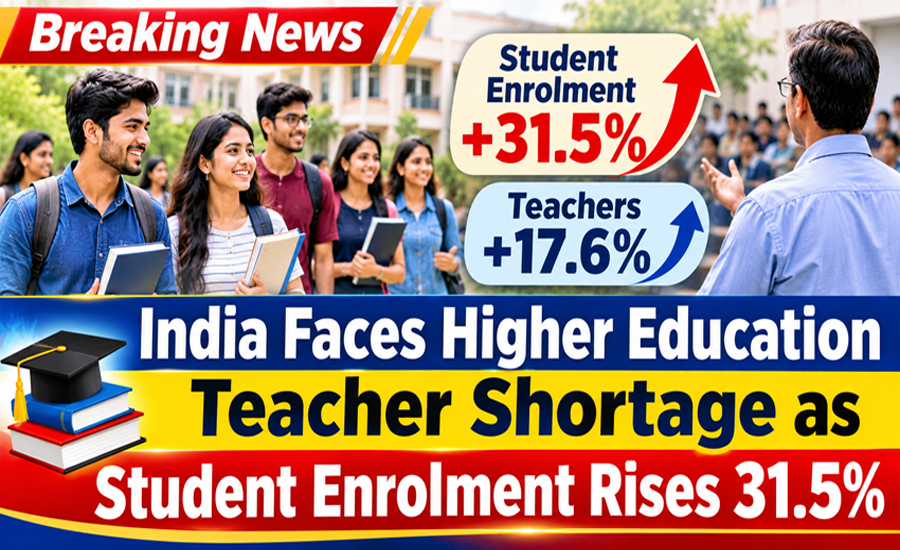
The working paper states that in the academic session 2014-15 to 2023-24, while the number of students enrolling in higher education institutes rose by 31.5 percent and reached about 4.50 crore, the number of teachers increased by just 17.6 percent and touched nearly 17.32 lakh.
Clearly, the higher education system in India is growing in terms of admissions, but teacher availability is lagging behind.
Higher Education Student Enrolment Grows Faster Than Faculty Strength
There has been a rising demand for higher education in India, which has led to an increase in enrolment in higher education institutions such as universities and colleges. There are many students enrolling in various courses including undergraduate, postgraduate, technical and professional courses thus putting further strain on the academic system.
According to the EAC-PM Working Paper, the number of students enrolled in higher education has risen by 31.5 per cent from the 2014-15 levels during the last decade. On the contrary, there has been a 17.6 per cent rise in the number of teachers during the same period.
It shows that there is a faculty crunch in higher education institutions in India as the number of students keeps increasing, and universities have to employ more professors, assistant professors, associate professors and others.
IITs and IIMs Face Significant Faculty Vacancies
However, the problem of lack of faculty members is not restricted to regular colleges and universities only. Even some of the most respected higher education institutions of India, including the Indian Institutes of Technology (IITs) and Indian Institutes of Management (IIMs) have had a number of vacancies.
As per the study report, in March 2023, there have been vacancies for about 39 per cent of the sanctioned faculty members at the IITs. In addition to this, there have been vacancies for 31 per cent faculty members at the IIMs.
The data brings in the concern regarding the presence of experienced faculty members in such institutions that significantly contribute to technical education, management education, research and innovation in India.
Why Is Faculty Recruitment Important for Higher Education?
Educators and lecturers are very much vital when it comes to the quality of education. Alongside with providing more colleges, universities and academic places, it is imperative to ensure that there are enough qualified faculty members.
There can be a few problems in higher educational institutions due to the dearth of teachers such as:
• Higher Number of Students per Teacher: An increase in the number of students and decrease in the number of teachers will limit academic support.
• Affected Teaching Process: Faculty shortage may impact classroom interaction and academics.
• Difficulty in Research: Universities need experienced faculty members who could supervise research, Ph.D. students and innovations.
• Extra Work for Professors: Professors would need to take care of the extra classes along with other responsibilities.
• Fewer Mentors for the Students: There could be limited individual mentorship provided by the faculty regarding the future career opportunities and further education.
It is important to resolve these issues to improve the Indian higher education sector.
India Needs More Teachers Alongside More Educational Institutions
One of the issues raised in the EAC-PM working paper pertains to the expansion of higher education in India in the coming years. More students, more facilities will not necessarily mean improved performance levels.
It is necessary for the government as well as higher educational institutions to ensure faculty recruitment and staffing of the teaching positions as well as ensuring that there is enough number of competent academics available.
Better working environment and chances of professional growth should be ensured in order to attract competent academicians into the profession.
Faculty recruiting process should be efficient and transparent in nature.
What Does This Mean for India's Higher Education System?
India aspires to make substantial progress toward increasing accessibility to higher education and improving its ranking in the global arena of academics. However, such objectives will be attained through balancing the admission procedures of students, infrastructural development, and faculty recruitment.
The increasing number of students represents a growing demand in higher education in India. Nevertheless, a relatively low rate of growth in the teaching personnel indicates that the process of faculty recruitment should be attended with the highest priority.
The vacancies identified at IITs and IIMs reveal that even top-tier universities need improved policies of faculty recruitment.
Ultimately, higher education quality depends not only on the number of students enrolled at universities but also on their successful mentoring and training.
The conclusion drawn from the analysis of EAC-PM reveals that India requires an additional number of teachers, not an additional number of university spots.