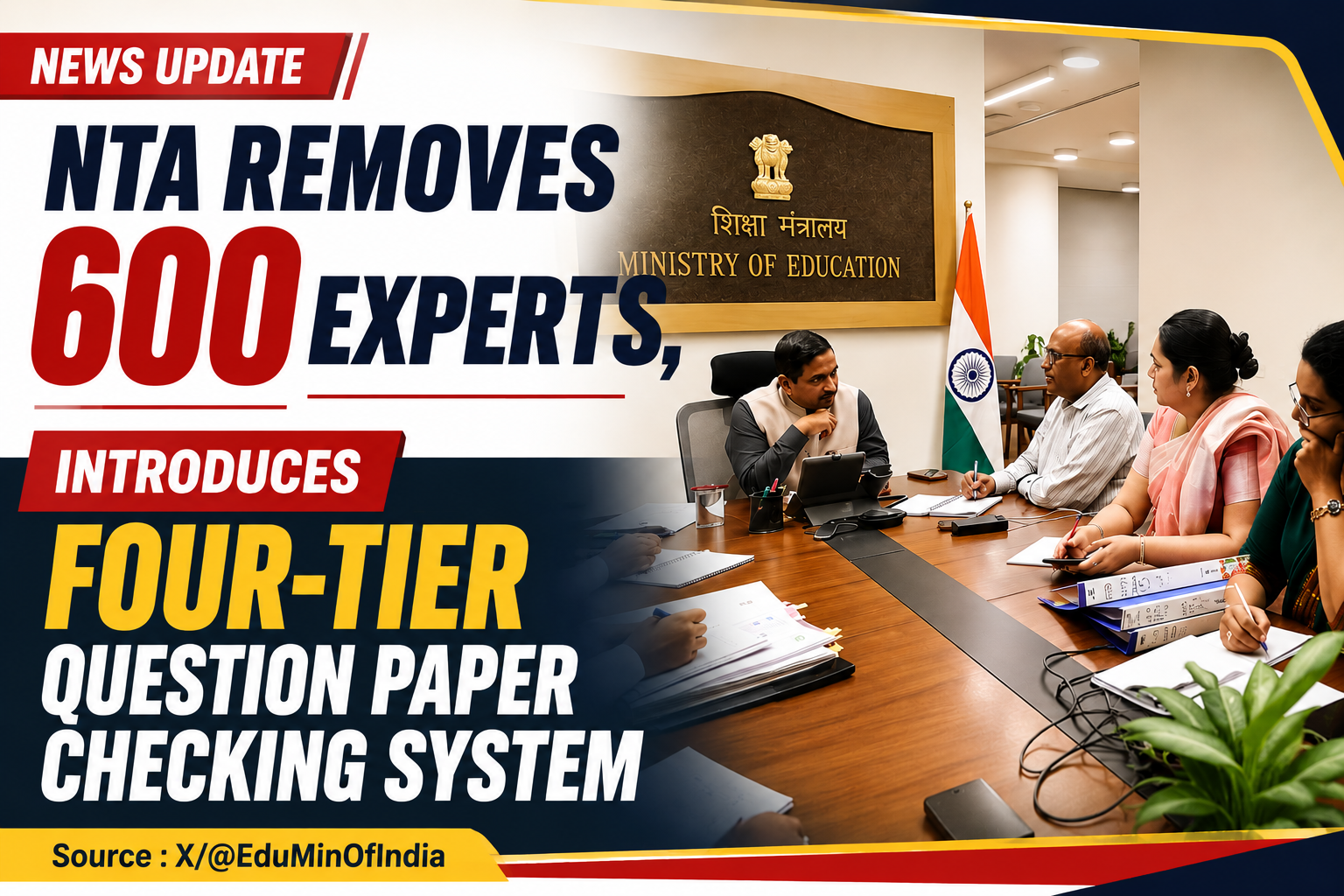
Reforms in NTA exams 2026: National Testing Agency (NTA) has started an entire revamp in the system of examinations conducted by the agency by replacing around 600 experts in the existing panels of the NTA and starting the procedure of introducing new experts. This is part of a broader scheme to bolster the reforms in NTA exams, quality of the question paper and security in major examinations at the national level.
The most important change being made is related to the four-layer question paper checking and verification process that has been introduced. In the improved system, question papers will be subject to several rounds of checks before being considered for any examination. This is meant to minimize mistakes, increase the quality of questions and maintain confidentiality.
NTA Removes 600 Experts From Existing Panels
It has been reported that NTA has already withdrawn about 600 experts from its current expert committees and is now recruiting new experts. This restructuring has been done in order to ensure the development of a strong expert committee in the subject who will prepare and examine the examination papers.
This restructuring has been done after many controversies related to the credibility and management of important entrance and eligibility examinations like NEET UG, JEE Main, and UGC NET. In the past few years, the NTA has been under controversy because of irregularities in exams and questions paper leakage.
Four-Tier Question Paper Checking System
This new four-level approach of question paper verification is going to ensure several layers of safety before the paper is provided to candidates.
In place of the one-layer approach of expert analysis, the question paper will have to go through a series of layers of checks. It would help in identifying the mistakes of an incorrect question, ambiguous language, syllabus mismatch, answer key issue, and more before the test.
It would be especially necessary for the NEET UG 2026, JEE Main 2027, UGC NET, and NTA entrance examination series, where a minor mistake in a question may impact thousands and millions of candidates.
Focus on NTA Exam Reforms and Examination Integrity
These recent changes have come within the scope of an overall program of reforming NTA examinations that aims at restoring the confidence of students, parents, and the academic world.
It has been suggested that the government is also taking measures to improve the security of the NTA examination centers. In one such measure, the deployment of CISF personnel at the NTA centers has been planned, thereby providing yet another physical security measure for the exam.
These reforms are important because the NTA exams will decide admission chances for many students all over India. NEET UG is used for admissions into medical courses, whereas JEE Main is used for admissions into engineering and UGC NET decides eligibility for Assistant Professor and Junior Research Fellowship positions.
Why the Four-Level Verification Matters for Students
For the students appearing in NTA exams 2026 and 2027, a stricter questioning paper examination system may prove helpful to be more confident about the examination.
Some of the possible advantages of the stricter checking system can include:
• Error in NTA questions papers
• Wrong or ambiguous questions
• Questions not belonging to the curriculum
• Errors in answer keys
• Difficulties due to lack of proper expert analysis
• Confidentiality and security issues
In case of competitive exams, where only one or two marks can make a big difference in rank, it becomes extremely important to ensure that all the questions are correct.
NTA's Changing Examination System
The current reorganization indicates that the National Testing Agency is heading towards adopting a more stringent examination system. It is anticipated that the National Testing Agency would give more importance to expert selection, testing question paper evaluation, technology, and examination security and accountability.
Four-tier testing of the question paper will enable more accountability in various stages of question paper preparation. Rather than relying on just one expert or one stage of checking, the multiple-checking process will help detect and rectify any possible issues before finalizing the question paper.
What Students Should Know
The students appearing for NEET UG, JEE Main, UGC NET and other NTA examinations are advised to continue with their syllabus, study plan and notifications related to the exam process. The new reforms will improve the examination process but should not alter the basic approach of candidates to the exam.
The real importance of this new notification relates to the efforts being made by NTA to increase transparency, reliability and security of the examination process. With the dismissal of about 600 experts and recruitment of new experts as well as introduction of a four-layer question paper scrutiny process, NTA is conducting one of its more comprehensive reforms of the exam process.
The success of these NTA reforms will depend upon how effective these reforms prove to be in terms of reducing errors, increasing security of examinations and improving their reliability.