The Benjamin Gupta School of Physical AI will focus on intelligent robotics, autonomous systems, scientific AI and real-world applications across engineering, healthcare, agriculture and other sectors.
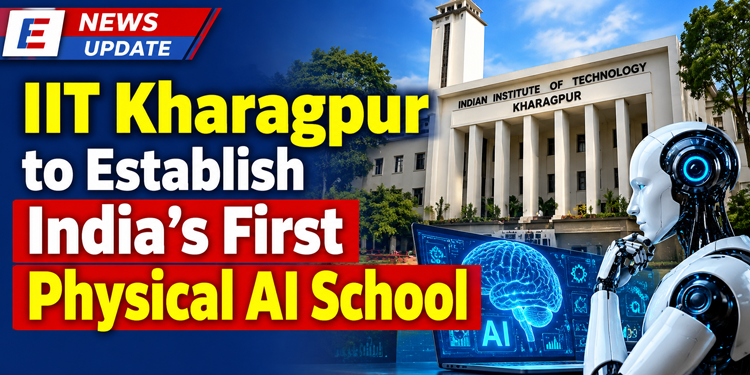
Benjamin Gupta School of Physical AI : Institute of Technology (IIT) Kharagpur is all set to launch India’s first academic school for Physical Artificial Intelligence (Physical AI), an endeavor worth INR 35 crores. The objective behind this venture is to contribute to the study and teaching of artificial intelligence through the creation of intelligent machines capable of understanding, interacting, and responding to the physical world.
The new institute is scheduled to be launched under a tripartite Memorandum of Understanding (MoU) signed between IIT Kharagpur, one of its most distinguished alumni Vinod Gupta, and the IITKGP Foundation USA. This would help enhance multidisciplinary research and equip learners with the skills required to use AI for solving scientific and engineering problems.
As per an announcement made by IIT Kharagpur on October 26, the venture will combine artificial intelligence, physics, engineering, biological sciences, and scientific knowledge in various disciplines.
Rs.35 Crore Investment for Physical AI Research
The project valued at Rs.35 crores will be funded by various sources. This includes Rs.12.5 crores from the Vinod Gupta family and Rs.10 crores from another alumnus of IIT Kharagpur who prefers anonymity. The remainder will be funded by IIT Kharagpur.
The funding will help develop the facilities for the Department of Artificial Intelligence and all related teaching and research activities.
The school is named after Benjamin Gupta, who was the son of Vinod Gupta and passed away recently. This initiative attempts to convert their personal tragedy into a valuable contribution towards scientific research and technology.
What Is Physical AI?
Conventional artificial intelligence is known to be connected with such activities as data analytics, language modeling, and image recognition, which are all related to digital operations.
Physical AI uses artificial intelligence technologies to work according to the laws of physics, sensing, experimenting, and intelligent control.
The idea of physical AI is the creation of systems that are able to analyze the physical environment, forecast system behavior, and make decisions while considering all possible limitations existing in the real world.
Examples include robots, which can change their behavior depending on the environment they move in; intelligent manufacturing, which reacts to the conditions of the equipment, and intelligent medical technologies that use information related to biology and clinics.
Physical AI aims at embedding physical and scientific principles to create intelligent systems.
Key Research Areas at the New School
Some of the key domains in which it is anticipated the Benjamin Gupta School of Physical AI will concentrate its efforts include:
• Physics-driven machine learning: The integration of scientific laws into AI models.
• Scientific AI: AI used to assist scientific discovery, modeling and experimentation.
• Digital twins: The creation of digital models of physical systems for simulating, monitoring and optimizing their operation.
• Intelligent robotics: The development of robots that can sense their environment and learn from it and perform various complex tasks.
• Autonomous systems: The advancement of intelligent machines and systems that can work more autonomously.
• Advanced sensing: The use of sensors and AI together to understand real-world conditions.
• Computational engineering: The application of AI in solving complex engineering challenges.
• AI-enabled experimentation: The use of AI to enhance experiments in order to make them faster and more effective.
These fields of study are supposed to help in overcoming the disconnect between algorithmic advancements in AI and the implementation of AI-based technology in real-world situations.
Applications in Healthcare, Agriculture and Industry
The proposed school will examine applications in fields where AI must be made to function effectively alongside physical systems and laws of science.
For example, in manufacturing, the use of artificial intelligence may enhance the processes of automation, maintenance and manufacturing. In the energy industry, AI can be used for energy systems modelling and optimization.
In agriculture, intelligent sensing and AI-based data analysis can help in crop, soil and environment monitoring. Climate and environmental technology research can be used for complex natural systems modelling.
There are many potential applications in the field of healthcare as well. By combining AI researchers with clinicians and biological scientists, the school seeks to stimulate technologies combining the algorithmic ability with knowledge about medicine and biology. These applications may include medical devices, diagnostics and clinical decision support systems.
Another field which can be benefited by an interdisciplinary approach to artificial intelligence research is intelligent infrastructure and engineering systems.
IIT Kharagpur’s Vision for AI Education
"The next big leap in the development of AI technology will have to do with revolutionising the way humans perceive and engineer the physical world," said IIT Kharagpur Director Professor Suman Chakraborty.
The institute stressed the necessity of transcending the concept of the black box for AI and underlined the significance of combining computational intelligence with the foundational science and knowledge for engineers, scientists, and physicians.
The institute plans to encourage the development of AI technology which would be effective and reliable, understandable, and responsible. This approach will be especially significant for such critical areas as safety-related applications.
The school will also serve as a place for collaboration between various academic institutions, industry, healthcare organizations, research labs, start-ups, and international partners.
Academic Programmes and Career Opportunities
The suggested school aims at interdisciplinary education and professional training along with advanced research. The academic programs are expected to start in the next academic session depending upon the required approvals.
It is envisaged that the suggested educational programs would consist of hybrid-mode master’s programs, executive education, professional certification courses and interdisciplinary courses in specific fields.
These programs are meant for those students, researchers and professionals from engineering, physics, biology and medicine who wish to incorporate skills of AI into their field of study.
This effort can provide openings to professionals who wish to pursue careers in robotics, autonomous systems, scientific computing, advanced manufacturing and AI-powered healthcare. But the admission requirements, program structure, fee structure and deadlines will depend upon the announcements of the institute.
Significance for India’s Artificial Intelligence Ecosystem
The setting up of the Benjamin Gupta School of Physical AI marks an attempt to increase the ability of India in research and development in AI technologies.
With increasing adoption of AI in industries, research, healthcare, and infrastructure sectors, there will be a need for individuals with knowledge of computer science and the systems in question.
Through scientific research, multidisciplinary learning, and industry-related research, IIT Kharagpur hopes to make a contribution towards developing AI technologies which can be utilized in the practical sense.
The school is expected to provide a platform for interaction among researchers, engineers, healthcare professionals and industry professionals in order to link AI advancements to the requirements of society and economy.