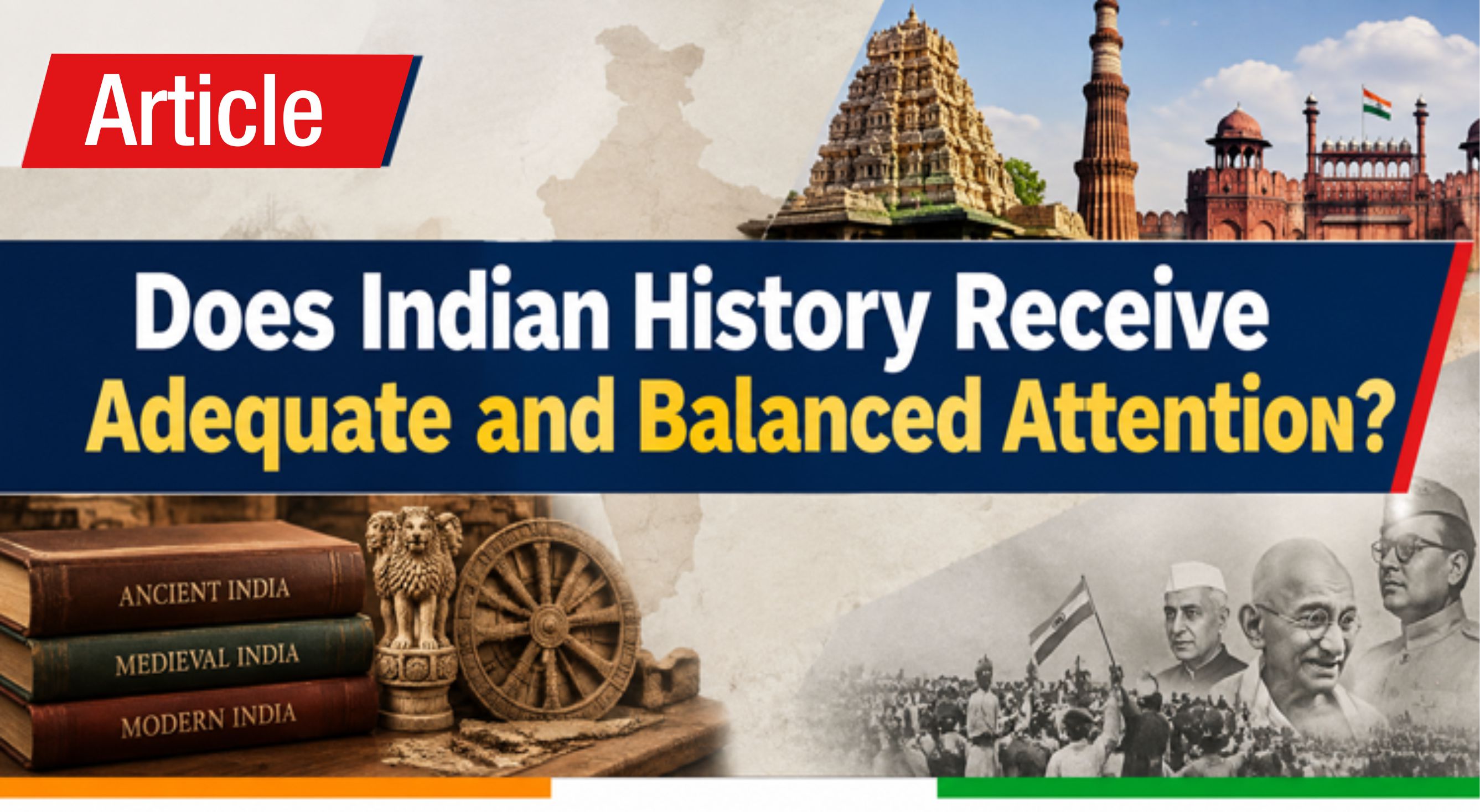
It can be said that Indian history is one of the longest and most varied traditions of any civilization in the world. The development of ancient kingdoms, religious and philosophical ideas, scientific discoveries, artistic achievements, the development of regional cultures, the period of colonization, the struggle for independence, and the formation of modern India are just some aspects of the history of this country. Nevertheless, it should be noted that the question arises, whether Indian history is given enough attention and whether it is paid equally? The answer to the question is rather ambiguous.
The first problem which can be considered is that the attention to different periods of Indian history may be quite unequal. The Indian history is rather well presented in school textbooks and in popular literature as well; however, there are some periods which are not given enough attention. For instance, there are many works devoted to ancient civilizations, great medieval dynasties, colonization and national movement; nevertheless, some other events such as the history of regional kingdoms, local societies, tribes, maritime connections, economy, and so on receive less attention than political history of empires.
The next issue of relevance relates to the need for regional balance. India is a land of tremendous geographical and cultural diversity. The history of north India has frequently been more relevant within the traditional historiographies primarily due to the fact that many great political empires originated from this region, as well as the fact that the colonial historians and subsequent historians depended heavily on the extant political archives. However, there are many aspects relating to the history of south India, northeast India, east India, west India, and central India that are very significant.
Then there is the issue of whose experiences are covered. The traditional history has usually focused on kings, politicians, wars, and institutions. The modern history research has been widening the scope of history to include social history, history of women, Dalit history, history of tribes, history of labourers, environmental history, etc. Such an approach can uncover facets of history that do not come out when the history is understood only from the actions of rulers and governments.
Colonial times provide yet another difficulty to overcome. The colonial regime affected India politically, economically, and socially in a tremendous manner; thus, it should be given adequate coverage. On the other hand, colonial writings on Indian history have been known to present Indian society under certain presuppositions that served the interests of the colonizers. For this reason, modern-day historians have studied colonial records in light of other sources such as archaeology, regional documents, oral traditions, literature, etc.
The history of the Indian movement for freedom is also an example of balance. Typically, one can find information about prominent leaders like Mahatma Gandhi, Jawaharlal Nehru, Subhas Chandra Bose, Bhagat Singh, and Sardar Patel in school textbooks. Their role is significant indeed, but the movement included millions of people and dozens of movements. Peasants, workers, women, revolutionaries, tribes, and even regions took part in the freedom movement along with many unknown people who contributed much to it. Attention to these aspects does not undermine the importance of famous leaders but provides a more detailed view of how India became independent.
Another aspect that should be taken into account is the politicization of history. As history defines the perception of identity, culture, and national feeling, it is highly political in its nature. Different social groups emphasize different facts and figures in the course of their history interpretation. That is why the education in history should teach students to distinguish between evidence and interpretation, opinion, and political discussion.
However, it would not be right to claim that the Indian history has been overlooked entirely. There exists a big group of historians, archaeologists, archivists, museums, universities, research institutes and periodicals which deal with the study of history. Indian history is also widely studied at schools and universities. The increasing popularity of archaeology, epigraphy, manuscripts, oral history, digitization, and multidisciplinary approach have added new dimensions to the understanding of the history of India.
Thus, the problem is not so much in the need for the increased amount of the studied history as it is in the improved quality of history studies. Balanced study of history should include all the regional and temporal aspects as well as social, economic, cultural, scientific, environmental, and political phenomena. In addition, it should acquaint students with prominent persons and common people and allow recognizing contradictions between historians.
To conclude, while Indian history has attracted significant interest, further balance and diversification is possible in its presentation. Rather than trying to displace one partial narrative with another, the teaching of history needs to incorporate many places, peoples, documents, and viewpoints. An adult appreciation of Indian history takes into account not just its successes but also its struggles, both continuities and disruptions, as well as the perspectives of elites as well as other people.