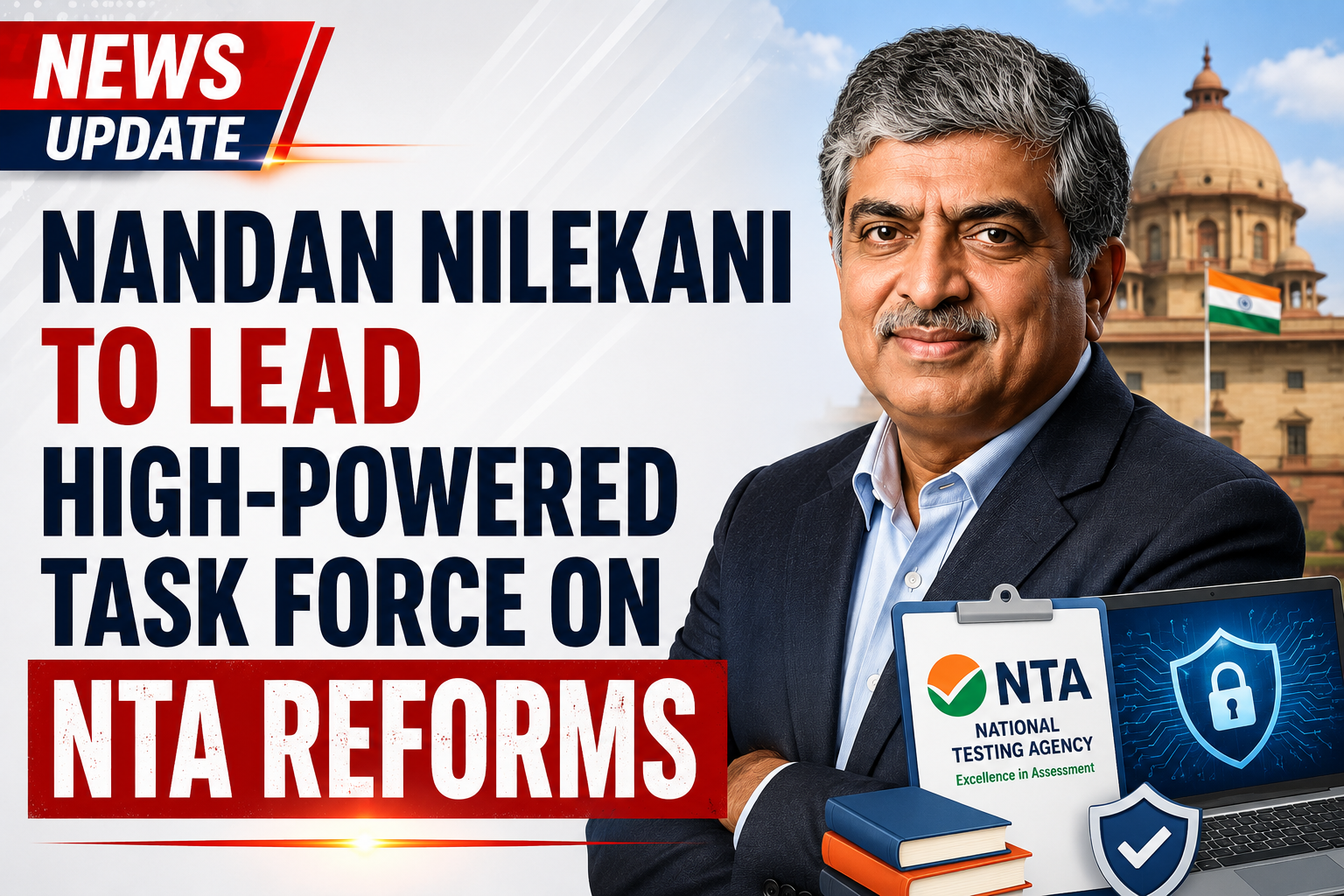
Nandan Nilekani NTA Reforms: In an unprecedented step taken by the Indian Government to increase the integrity and authenticity of the examination process in the country, a committee has been constituted by the Central Government to oversee reforms in the National Testing Agency. The government has entrusted this task of reforming the National Testing Agency to Infosys co-founder and Aadhaar creator Nandan Nilekani.
This decision comes at a time when the examination process has been under increased pressure due to issues regarding paper leakages and other problems in the conducting of national level entrance examinations. Through this decision, the government wants to create an examination environment which would be secure, effective, and futuristic for millions of students in the country.
Why the Government Has Formed the Task Force
Some of the biggest and toughest entrance examinations of India are being conducted by the National Testing Agency. This includes NEET (National Eligibility cum Entrance Test), JEE Main (Joint Entrance Examination), CUET (Common University Entrance Test), UGC-NET, and a number of other examinations related to recruitment and admission in different fields.
Millions of students every year rely upon such examinations to ensure their admission in medical colleges, engineering institutions, central universities, and other institutions of higher education. Even a minor problem with the conduct of such examinations would mean much more than just problems for the students.
Thus, the formation of the task force clearly represents the government's intention to hold the examinations in a fair and reliable manner.
Nandan Nilekani's Role in the Reform Process
Nandan Nilekani has been acclaimed for spearheading some of the most revolutionary digital initiatives in India. As the founder Chairman of Unique Identification Authority of India (UIDAI), he was responsible for formulating the Aadhaar digital identity project, one of the biggest biometric identification systems globally.
His background in digital governance, technology implementation on a grand scale, cyber security, and digital infrastructure will certainly be helpful in steering reforms within India’s exam process framework.
Under his leadership, it is expected that the task force will come up with some practical technological solutions that will immensely enhance the operations of the NTA, eliminating cases of malpractice and corruption.
Technology at the Centre of Examination Reforms
One of the key aims of the committee is to use modern technology to increase the security and efficiency of the exams.
Some of the key tasks of the task force include investigating the use of:
• Artificial Intelligence (AI) for supervising the examination centers
• Encryption and transfer of question papers digitally
• State-of-the-art cybersecurity techniques to ensure no data breaches occur
• Biometric identification of candidates
• On-site monitoring of the examination centers
• Fraud detection software systems
• Software-based auditing techniques
• Cloud-based examination system with improved security features
It is also likely that the committee will investigate the use of predictive analysis to detect suspicious behavior before the examination process and improve the digital security to prevent paper leakages.
Comprehensive Review of the National Testing Agency
The committee is not limited to improving the technological aspects alone but will also conduct an overall review of the organizational structure of the National Testing Agency.
Some of the topics that will likely be reviewed are as follows:
• Institutional governance and accountability
• Examination planning and logistics
• Paper setting and its safekeeping
• Examination centers management
• Candidate authentication process
• Security measures
• State agency and examination authority coordination
• Crisis management during examinations
It is believed by experts that an improvement in administration, along with technology, would help develop a more robust examination system.
Restoring Public Trust
Credibility of examinations is crucial in India's education sector. Annually, lakhs of students prepare over several years for entrance examinations, and therefore there is a need for fair and transparent examinations.
There have been various issues regarding examination security lately, which has increased public demands for increased protection and accountability. There have been consistent demands for change to ensure fairness in the opportunities provided to all candidates.
The recruitment of Nandan Nilekani is seen as a positive step towards restoring credibility through technology.
Possible Recommendations from the Committee
While the recommendations from the committee have not been released, educationists anticipate several key changes being proposed.
These include:
• Encryption of examination papers end-to-end
• Surveillance systems powered by AI
• Biometric digital authentication
• Better candidate identification management
• Cybersecurity framework upgrade
• Secure digital archiving of examination material
• Policies for examination centers to follow
• Greater transparency in examination results processing
• Auditing of examinations processes
• The upgrade of NTA’s digital infrastructure
The committee could also propose a continuous monitoring system that can detect any anomaly before it impacts the examination process.
Impact on Students and Educational Institutions
The suggested reforms, if successfully implemented, may bring about substantial improvement in the examination experience of millions of students who appear for such examinations.
The students will benefit through:
• More transparency during the conduct of examinations
• Less risk of leakage of papers
• Quicker redress of grievances
• Enhanced security of examinations
• More confidence on results
• Superior digital services for registration and communications
The educational institutions will benefit through enhanced credibility of the admission process through reliable and secure examination systems.
Strengthening India's Digital Education Infrastructure
The country has made itself a leader when it comes to digital infrastructure for the public due to projects like Aadhar, UPI, DigiLocker, and many others. It is clear from the choice of Mr. Nilekani by the government that the idea of using the same principles in the education industry will be employed.
It is suggested that the inclusion of digital technology in the examinations system will ensure not only a decrease in cheating cases but also more efficiency, lower cost, and better exam conditions for the students.
A Significant Step Towards Exam Reform
It can be said that the creation of a highly empowered task force by Nilekani is amongst the most important reform steps taken by the Indian examination system in recent times. Through an innovation of technology combined with the reformation of institutions, it is hoped that the government would be able to create an examination system that will be future-proof and meet the needs and expectations of millions of students.
With the initiation of the task force, many people in the education sector would be watching out for the recommendations of the task force, which could very well bring about major changes in the way National Testing Agency functions, as well as in the conduct of examinations in India.
In case these reforms prove to be successful, then not only would they increase transparency, security and accountability within the system but they would also bring back trust in an extremely important organization of the country.