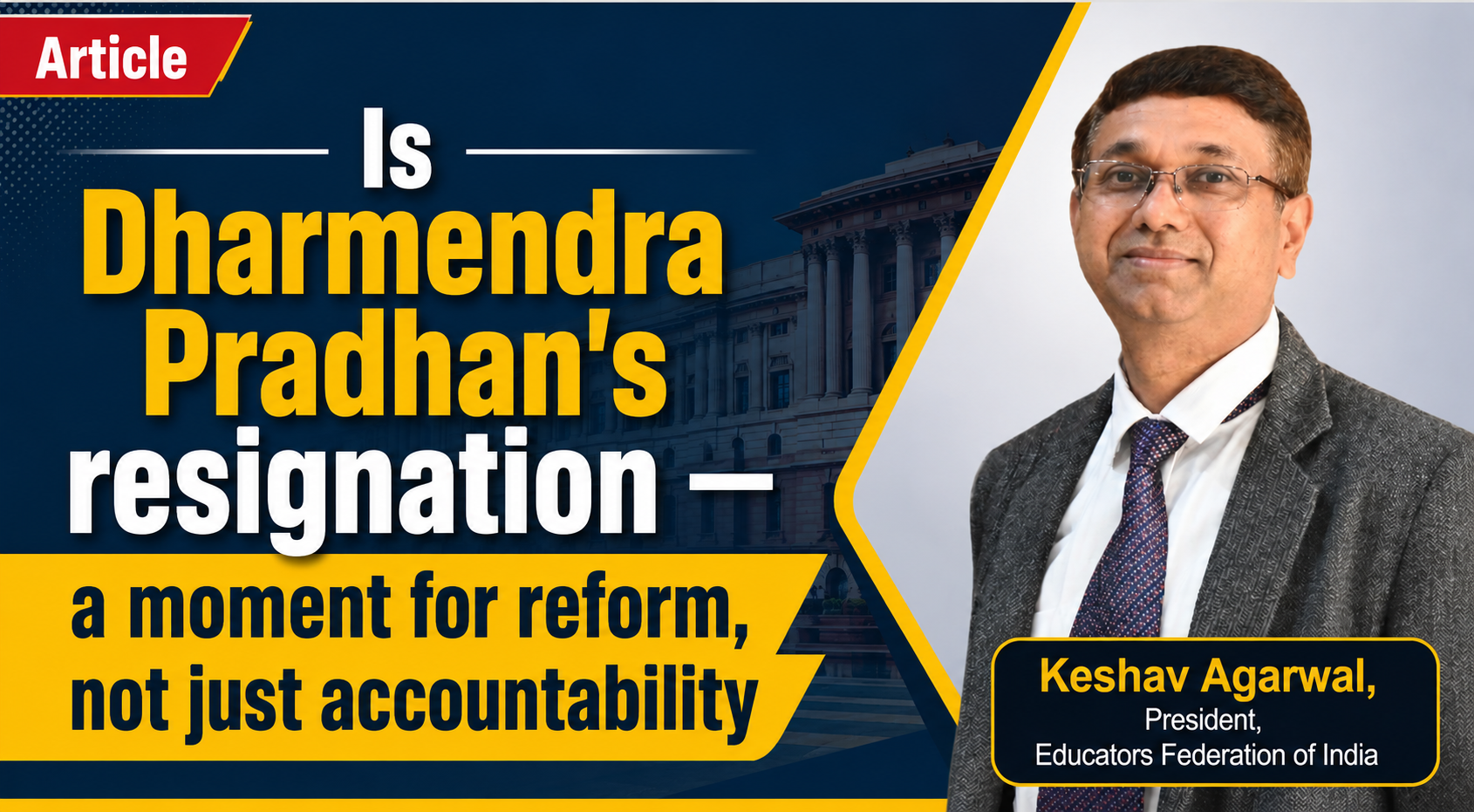
Dharmendra Pradhan's resignation as Union Education Minister following the paper leak crisis is a moment of accountability, but resignation alone is not the solution. What India needs now is decisive reform — starting with paper leak prevention, and going far deeper into how our education system prepares students for real opportunity.
On paper leak reforms:
Tamper-proof digital exam delivery, biometric-linked entry like digi yatra with no human involvememt, and real-time forensic monitoring — with strict, time-bound criminal accountability for leaks, not committees that report a year later and reports not fully implemented two years later.
If CBT is to be implemented across entrance exams nationwide, we need roughly 10 lakh CBT-enabled seats built up urgently so that normalisation process doesn't create another hurdle after results in exam like neet.
CBSE needs a genuine revamp — its examination department is in poor shape, and for board exams 2027 they cannot afford a fiasco as in 2026, the focus must be on fixing fundamentals, not window dressing.
On curriculum and exam structure:
The three-language policy should apply only till Class 8; beyond that, students should have the freedom to choose.
CUET should be scrapped or restructured for specialised streams like journalism, where the current format doesn't work and many rural area students don't even take the exam due to logistic problems like far away centers and also rural students do not have access to computers for practice and coaching like urban students.
Board exam scores should carry 10–15% weightage in JEE, NEET, CUET and similar entrances — otherwise schools will become redundant. Class 12 also needs one uniform syllabus across boards and a uniform time and corroboration with entrance scores in case of major variations.
On regulation and accountability:
Private universities and coaching institutes need proper regulation and monitoring, or students and parents will keep being cheated in the name of education.
Rank-buying must be made a punishable offence — for both institutes and parents involved.
On capacity — the immediate fix:
Government colleges in high-demand cities wherever possible should run in two shifts using existing infrastructure, instantly increasing seats without waiting years for new construction — and simultaneously creating contractual teaching and support-staff jobs, addressing both the seat crunch and the employment crisis at once.
On school reform:
The rigid, one-size-fits-all structure must end. From Class 8 onwards, students should choose a Major and a Minor subject based on aptitude — a student passionate about music should be able to take it as a Major and Maths as a Minor, without penalty.
The three language policy should be compulsory till classes 7th or 8th and after that the choice given to students to opt for third language as a choice.
On employability — the real gap:
Our education system is still built around rote scoring, not what employers actually need — problem-solving, communication, digital and vocational skills. This mismatch is a big reason behind the mass youth unemployment protests we're seeing today. Reform can't stop at exams; it must extend to curriculum, skilling, and industry-linked learning at both school and higher-education levels.
The government must treat education — school and higher — with the urgency this moment demands, before the damage becomes harder to reverse.
Keshav Agarwal
President
Educators Federation of India