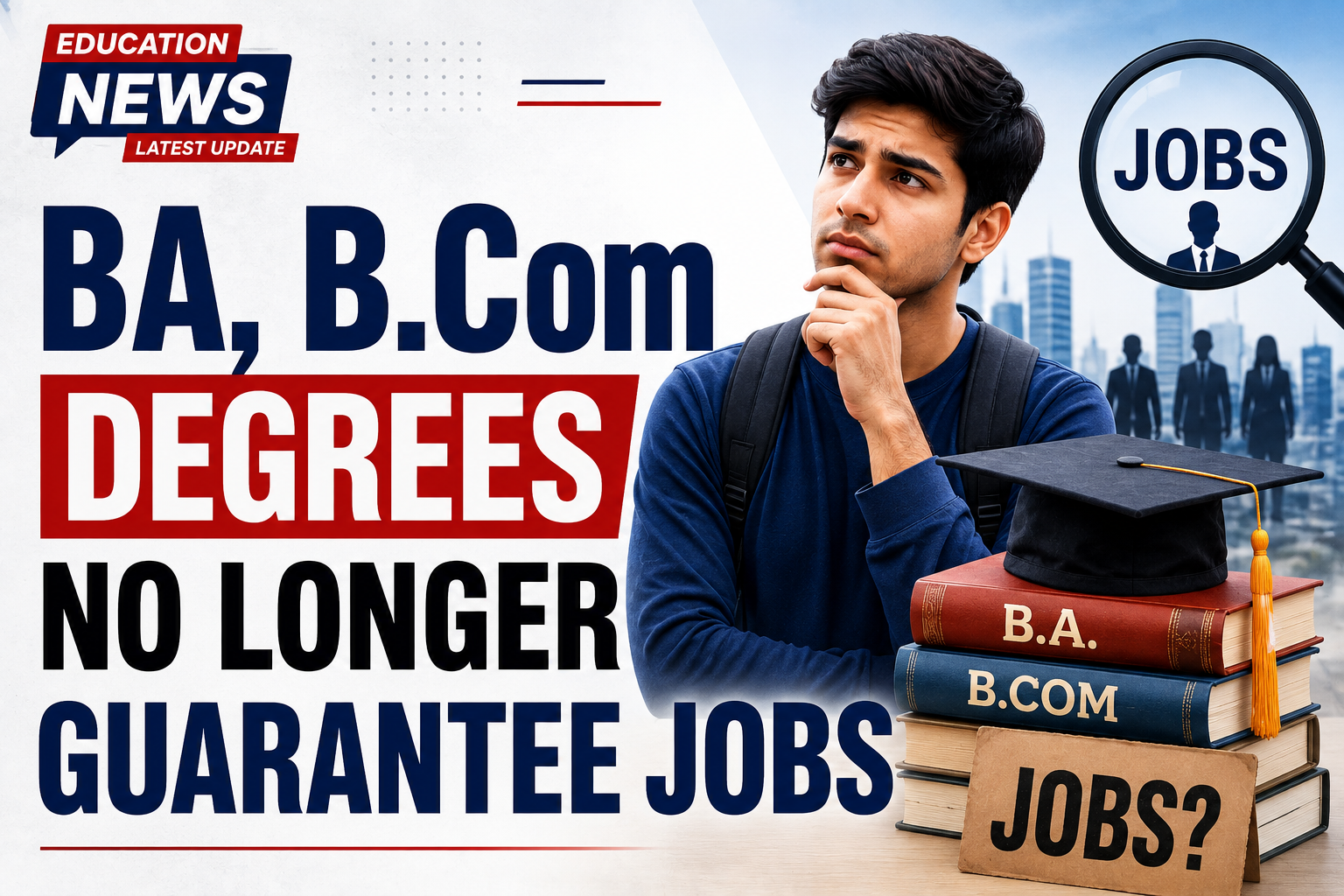
For decades past, a bachelor’s degree used to be the basic passport for securing jobs in India. The completion of BA or B.Com used to be an effective ticket for securing a stable career, be it banking, finance, administration, teaching, sales or governmental jobs. But the situation is rapidly changing. These days, having a degree is not enough anymore to get oneself a decent job.
According to a recent NITI Aayog working paper, there have been growing worries about the poor employment prospects for generic degrees like BA, B.Sc and B.Com. In particular, the report states that more than 90% of the graduates work in positions which have little to do with their education; the rate of unemployment of graduates is substantially higher than the rate of unemployment in general.
That is not to say that BA or B.Com degrees are no good anymore. It is merely a sign that things change drastically in terms of requirements of prospective employers. Degree gets one into the door but the skills, knowledge and expertise make one hired.
The Changing Value of a BA Degree
The conventional bachelor's arts program entails courses like English, history, politics, economics, sociology, and psychology. These courses remain relevant from both educational and social perspectives, yet, students who want to get a BA might encounter some challenges while trying to compete for jobs requiring certain job skills.
Based on the India Skills Report 2026, the employability of BA graduates reached the level of 55.6 percent. In contrast, the employability of B.Com graduates was approximately 62.8 percent, of BE/BTech graduates – 70.2 percent and of MBA graduates – 72.3 percent.
These numbers prove that the issue goes beyond having a diploma. The modern employers want to hire people capable of demonstrating their skills.
Thus, a BA student who has skills in digital marketing, content writing, data analysis, speaking foreign languages, public relations, researching, or working with artificial intelligence will have better chances of getting hired than one who solely studies in class.
Why B.Com Graduates Are Also Facing Pressure
The Bachelor of Commerce degree has been one of the most sought after undergraduate degrees in India. This degree gives the knowledge about accounting, economics, taxation, and business and finance. But the contemporary financial and corporate world has become more technology savvy.
Today’s employers are searching for those graduates who have an understanding of accounting software, Excel, financial modeling, GST, data analytics, enterprise software and digital banking systems. Therefore, the B.Com graduate lacking practical knowledge will face difficulties in competing with candidates who have certifications and work experience in addition to their degrees.
On the other hand, this does not mean that the outlook of this degree has become completely bleak as the India Skills Report 2026 data published by NITI Aayog shows that the B.Com degree is about 62.8 percent employable.
Degree vs Skills: What Employers Want
The most significant shift within the employment sector is the rise in the relevance of skills. The Mercer India Graduate Skill Index 2025 report states that only 42.6 per cent of Indian graduates evaluated were deemed overall employable. The research, which examined over a million students at over 2,700 different institutions, also emphasized the growing relevance of critical thinking, communication and learning agility.
This implies that instead of asking, “Which degree shall I take?” Students must also ask, “Which skills shall help me become employable after graduation?”
For instance, a B.Com student can learn advanced Excel, Power BI, financial modeling, Tally, GST compliance, and basic data analytics. A BA student can gain skills in digital marketing, journalism, social media management, research, graphic design, or content creation through AI.
Specialisation Is Becoming the New Advantage
The job market is getting more attractive towards candidates who have the combination of general education and specific skill sets.
A general education program can be an option; however, specializations can set a direction for career. For example, a BA in Economics along with data analytics can lead to research as well as business analysis career. A B.Com program combined with financial analytics can provide better career options in banking and corporate finance. Similarly, a BA in English along with digital marketing and content development skills can lead to a career in communications and media.
That is the reason why the institutions should also change their curriculums accordingly. As suggested by NITI Aayog, there should be better connection among education, skills and employment programs.
Internships and Practical Experience Matter
One more serious disadvantage of conventional undergraduate education is low exposure to real-world organizations. The students may study the theoretical part for three years and complete their education without even getting any internship or doing some project.
Such internships help the students get knowledge about the norms of the working world and get experience to showcase at interviews.
Project is of equal importance. The student of B.Com could make the financial analysis of the company, while the one with BA degree could perform the research project, run the digital campaign or compile the portfolio.
What Students Should Do Now
Those working towards a BA or B.Com degree do not have to panic and believe that their degree will have no value. What they need to realize is that graduation marks the beginning of their career, not the end.
They need to concentrate on the following things: digital skills, communications, internships, specialized certification, and projects. Even AI knowledge has become important in the workplace.
The bottom line from the employability statistics being generated is quite clear: The degree counts, but the degree is just not enough.
Education Must Move From Credentials to Capabilities
There is a very crucial shift coming in India’s education system. It is shifting from the old route of school, college, degree, and then getting a job to a far more complex route of education, skills, internship, certification and lifelong learning.
It opens up many more opportunities for students. For instance, a BA or B.Com degree holder is not bound to follow the usual route of jobs that go with their degree anymore. With appropriate skills in addition, one can enter into newer fields of digital business, analytics, fintech, marketing, human resources, content and consulting.
As always emphasized by Educationkhoj.com in the context of education and careers, students need to look past their degrees and understand the skills requirements of the new job market.
The future isn’t just for people holding technical degrees. It is for graduates who have both theoretical understanding and practical skills, adaptability and an understanding of industry requirements.
This is why describing degrees like BA and B.Com as “degrees which don’t attract jobs anymore” is an overstatement. The correct statement to make would be that it’s now not enough to graduate with just a degree. The perfect combination is recognized degree plus relevant skills and experience as well as ability to learn constantly.
For today’s students, the winning equation of success would look like this: get your degree, develop your skills, gain experience and keep on learning.