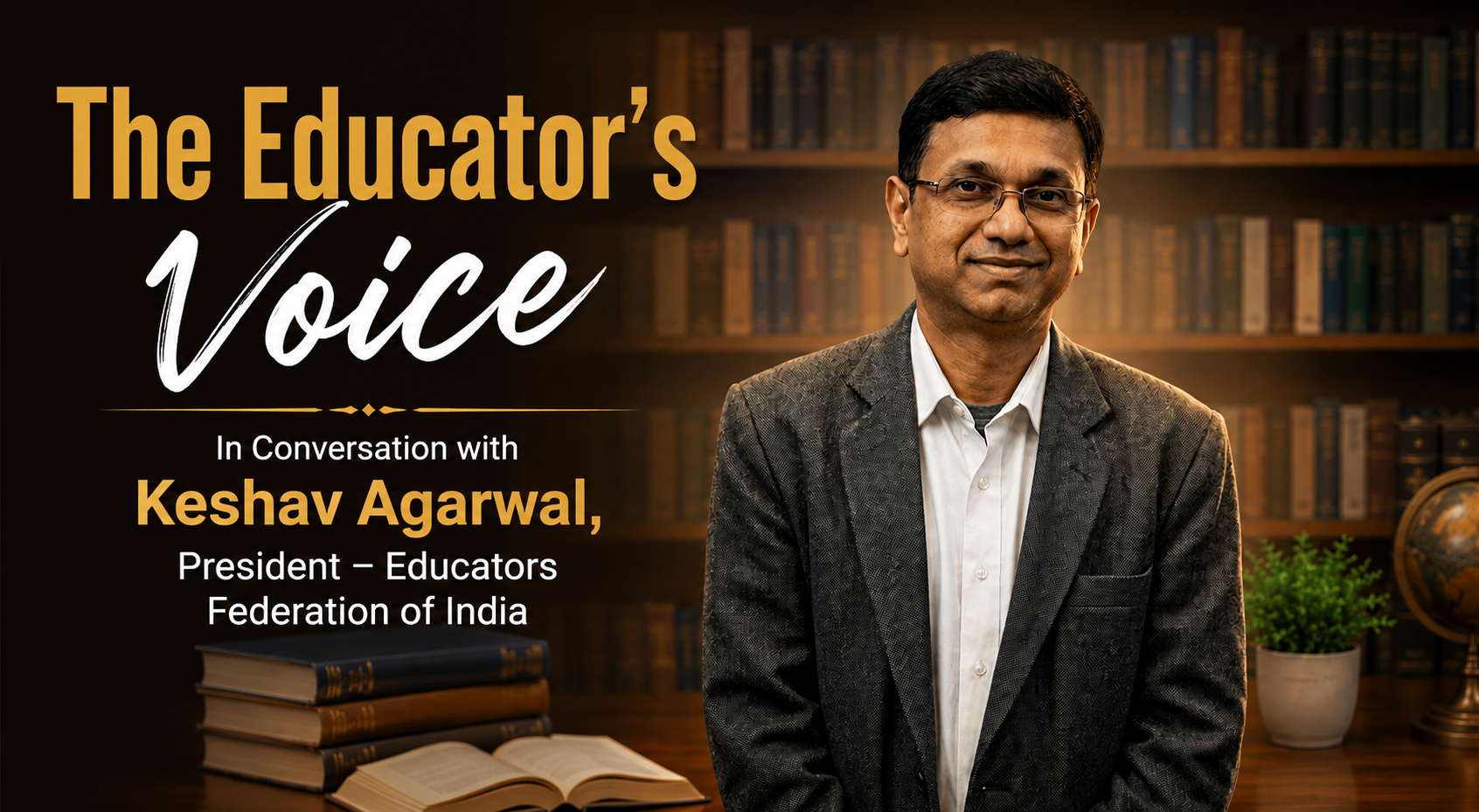
The Educator’s Voice In Conversation with Keshav Agarwal
On uniting India's teachers, restoring faith in learning and examinations, and preparing classrooms for the age of AI
Q1. To begin with, could you tell us about the vision and key objectives of the Educators Federation of India?
Our vision is simple to state and hard to build: connect every educator in this country and give them one collective, credible voice.
India has lakhs of teachers, principals and academics doing remarkable work, but mostly in isolation. A breakthrough classroom practice in a small town in Kerala may never reach a teacher in Rajasthan. A problem that teachers in Delhi raise year after year may never reach the desk of the policymaker who could actually fix it. The Educators Federation of India exists to close that distance.
We are not here only to speak up when there is a grievance. Our real objective is to build a national network where educators from schools, coaching, colleges and educational institutions exchange practices, debate reforms and shape policy — not just receive it.
For decades, the teacher has largely been seen as the last person in the chain, the one who implements what others decide. I want that order reversed.
“Educators must not remain the last-mile implementers of education policy — they must become its first-mile contributors.”
A teacher who has spent twenty years in a classroom understands a child, a parent and a system in ways no file or statistic ever will. That understanding has to enter policymaking, not stay outside it.
Q2. What are the biggest challenges currently facing educators, teachers, and educational institutions in India?
I would point to five.
One, the gap between policy on paper and reality in the classroom — the same reform can look entirely different in a metropolitan school and a village school forty kilometres away.
Two, the administrative load on teachers, who are today expected to be instructors, data-entry operators, event managers and compliance officers, often on the same day.
Three, the pace of technological change, especially AI, where what counted as adequate digital literacy three years ago is already outdated.
Four, a persistent trust deficit around examinations and assessment — parents, students and even teachers have started to doubt whether the system evaluates fairly. That trust has to be earned back, deliberately and visibly.
And five, the continuing inequality of infrastructure, teacher availability and exposure between institutions.
Underneath all five sits one larger truth: we keep investing in buildings, curricula and technology, and forget to invest, with the same seriousness, in the person standing in front of the class.
Q3. How do you assess the implementation of the National Education Policy (NEP) 2020 so far? What areas require greater attention?
NEP 2020 gave India the right direction — multidisciplinary learning, foundational literacy, competency-based education, flexibility, vocational exposure, and a lower dependence on rote memory. Initiatives like PARAKH and the PM SHRI schools are genuine attempts to carry that vision forward.
But six years on, our challenge is no longer the quality of the policy document. It is the consistency of what happens after it leaves the ministry. The same reform reads identically in every state's circular and then plays out completely differently in a metro school, a small private school and a government school in a district headquarters.
So the question I ask is not “has NEP been implemented” but “has it changed what actually happens between a teacher and a child inside that room.” That, to me, is the only honest measure.
One structural reform I would like to see seriously debated is giving students genuine freedom to choose a major and one or two minor subjects from Class 8 onwards, rather than forcing every child into an identical stream at fifteen. A child who knows by Class 8 that mathematics excites her and history does not should be allowed to lean into that, with guidance, well before board-exam pressure forces a rushed decision.
Beyond this, we need sustained attention on teacher training, foundational learning, vocational education that is genuinely respected rather than tolerated, assessment reform, and resources for smaller and rural schools. I would also push for a standing, continuous feedback channel from educators into NEP implementation — teachers and principals reporting, at regular intervals, what is working, what is not, and what needs correction. Policy has to be able to learn from the classroom it created.
Q4. Teachers are at the heart of the education system. What steps do you believe are necessary to improve their professional development, working conditions, and social recognition?
Teacher development has to move away from the occasional weekend workshop and become continuous — exposure to new pedagogy, AI tools, assessment methods, child psychology and inclusive practice, spread across the year, not compressed into a certificate before the session ends.
A teacher learns best from another teacher who is doing it well. Picture a national platform where a science teacher in Bengaluru demonstrates a classroom technique that is watched and adapted by thousands of science teachers across the country, or where a primary-school teacher in a rural school shares what actually improved reading scores in her classroom. That culture of open sharing is what we should be building.
Working conditions matter just as much — less paperwork, adequate teaching resources, reasonable autonomy in the classroom, and a career path that is transparent rather than arbitrary.
And society has to change how it looks at teachers. We celebrate the topper and rarely name the teacher who made that result possible.
“If we want teaching to attract the finest minds of the next generation, we must first make it a profession that generation is proud to choose.”
Q5. How can schools and educators better prepare students for a rapidly changing job market driven by AI, automation, and emerging technologies?
The one mistake we cannot afford is trying to predict exactly which jobs will exist twenty years from now. Many of them do not have names yet.
So schools must build what does not go out of date: critical thinking, communication, creativity, collaboration, adaptability, and sound ethical judgement, alongside genuine digital and AI fluency.
This also means we finally stop treating a certificate as proof of competence. Employability, not the number of certificates in a file, has to become the measure of readiness. A student should be assessed on what she can actually do with what she knows, not merely on how much of it she can recall on a given morning.
AI will keep making routine information retrieval easier and cheaper. What will not become cheaper is human judgement, curiosity, and the ability to ask a genuinely original question.
Q6. What is your perspective on the growing use of AI in education? Should schools focus more on adopting AI tools or on teaching students how to use AI responsibly?
Both, and neither should wait for the other. Schools must use AI, and schools must teach AI.
Used well, AI can help a teacher prepare differentiated material for a mixed-ability classroom, spot learning gaps early, support slower learners, translate content across languages, and take some of the repetitive load off a teacher's day.
But AI literacy cannot mean knowing which chatbot to open. Students have to understand verification, bias, privacy, plagiarism, intellectual ownership and misinformation — the same seriousness we already bring to laboratory safety or examination integrity has to extend to AI use.
This is the core of the philosophy I keep returning to in every forum I speak at: AI plus HI. Artificial Intelligence must serve Human Intelligence, never replace it.
AI + HI = Results Beyond Imagination
A student who uses AI to finally understand a concept that had confused her for weeks is learning. A student who asks AI to do the thinking for her is quietly forgetting how to think. That distinction has to be taught as deliberately as any subject on the timetable.
Q7. There is increasing discussion about reducing the academic and administrative burden on teachers. What reforms would you recommend?
We have to accept one non-negotiable principle first: a teacher's primary job is to teach. Every hour taken away from lesson preparation is an hour quietly taken away from a child.
Schools and state departments need an honest audit of every register, report, portal entry and compliance form currently demanded of teachers. If a piece of information already exists digitally somewhere in the system, it has no business being asked for again in a new format.
Technology was supposed to reduce administrative work. Too often it has simply digitised the same bureaucracy and added a login screen to it. Schools also need dedicated administrative staff so that teachers are not routinely pulled into clerical work that has nothing to do with teaching.
A teacher's time is one of the scarcest and most valuable resources in the entire education system. We should start treating it that way.
Q8. How can India bridge the gap between school education, higher education, vocational training, and industry requirements?
We need to knock down the walls between these four worlds. Too many students reach Class XII without having set foot in a workshop, a laboratory outside their own school, a farm, a design studio or a professional office.
That exposure has to begin far earlier — schools partnering with universities, industries, artisans and entrepreneurs for internships, mentoring and real problem-solving projects, not just career-day posters.
Vocational education, above all, needs a change in how society sees it. For generations we have quietly told children that the academic path is superior and the vocational path is a fallback. That hierarchy has to end. A country needs its researchers and its doctors, but it needs its skilled technicians, electricians, designers, programmers and healthcare workers just as much. Education's job is to help a child find where genuine aptitude meets real opportunity — and then to respect whichever path that turns out to be.
Q9. What role should private schools play in strengthening India's education system, and what policy support do they need from governments?
Education in India is too large a mission to be reduced to a government-versus-private argument. Government schools, aided schools and private schools are all, together, educating this country's children.
Private institutions can contribute innovation, faster teacher development, and models worth studying and scaling. At the same time, accountability, safety, learning quality and transparency about fees and outcomes cannot be optional.
What private schools actually need from government is predictable, rational regulation — rules that protect students and parents without treating every institution as a suspect and without burying schools under compliance for its own sake. The relationship should slowly move from regulator-and-regulated to genuine partnership.
Q10. Parents often face concerns related to rising school fees, quality of education, and transparency. How can schools and parents build greater trust and cooperation?
Trust starts with transparency. Parents deserve clarity on fee structures, academic expectations, assessment methods and the actual value being delivered for what they pay — not vague assurances.
But education works best when both sides remember they are partners, not adversaries. Schools should build structured parent engagement that goes beyond the post-exam PTM — sessions on adolescence, digital behaviour, mental health and career pathways, held through the year, not only when there is a problem to manage.
And parents, in turn, have to accept that a child's education cannot be reduced to a single number on a report card. The best relationships I have seen are ones where the school genuinely understands the child, the parent trusts the teacher's judgement, and both sides talk before a small issue becomes a conflict.
Q11. What are your views on the increasing emphasis on skill-based, experiential, and competency-based learning rather than traditional rote learning?
This is one of the most important shifts under way in Indian education. PARAKH's move towards competency-oriented assessment, and its Holistic Progress Card, represent a genuine national attempt to evaluate more than recall.
But we must be careful that competency-based education does not become a phrase printed in the textbook while the classroom next door still runs on dictation and rote answers. If we want competency-based assessment, we need competency-based teaching to precede it — students investigating, experimenting, presenting and solving, not just reproducing.
Take a single topic like water conservation. Instead of asking a child to define it, ask her to audit water use in her own school and propose how to cut it by 20 percent. One exercise, and she has touched mathematics, science, environmental studies, communication and civic responsibility together.
The same logic applies far more widely than we usually allow. A monument does not have to live only in a history chapter — its architecture is geometry, its construction is physics, its scale and materials are mathematics, and its story is social science. Real life does not arrive divided into subjects, and I see no reason our teaching should insist on dividing it that way.
Q12. How can educators ensure that academic excellence is balanced with students' mental well-being, creativity, values, sports, and extracurricular development?
We need to redefine what we even mean by an excellent student. A marksheet cannot measure the whole human being in front of us. A child may be an outstanding mathematician, or an outstanding athlete, musician, debater or organiser — and our system too often has room for only the first kind of excellence.
I would like schools to seriously consider a structural change: a dedicated track for students with genuine, demonstrated talent in sports, arts or other extracurricular pursuits, where the bulk of their time and energy goes into that pursuit, and the core academic load is deliberately lighter — closer to 30 percent of the usual weight — rather than asking every child, regardless of gift or ambition, to carry an identical academic burden. A future Olympian or a future classical musician should not be made to choose between their calling and their board exam.
Mental well-being cannot be addressed only after a child reaches a breaking point. Schools need preventive systems in place well before that — accessible counselling, teachers trained to notice early signs, realistic academic expectations, and a culture where asking for help is treated as normal, not as weakness.
Education should produce capable professionals, yes. More importantly, it should produce balanced, grounded human beings.
Q13. What steps are needed to improve the quality of education in rural and economically disadvantaged communities?
Infrastructure matters, but a new building alone has never taught a child to read. We need enough teachers, reliable connectivity, strong foundational literacy and numeracy programmes, libraries and laboratories that are actually used, and consistent academic support rather than one-off interventions.
UDISE+ now gives us a genuine national picture at the school level, which means we can finally target support instead of applying the same solution everywhere regardless of local need.
On access, I believe we also need the courage to revisit who our support reaches. There are genuinely deserving backward and economically weaker students across every category who are still being missed by current criteria, while some who are comfortably placed continue to benefit. Categories like EWS deserve an honest relook to ensure the support is reaching real need rather than a proxy for it.
A strong local model brings in community, local language, local livelihoods and local knowledge, while still connecting children to national and global opportunity. Technology can carry excellent teaching far beyond metropolitan India — but only when it arrives with devices, connectivity and a teacher who knows how to use it, not as a substitute for any of the three.
Equality in education was never about giving every school the identical thing. It is about making sure a child's PIN code stops deciding the size of her future.
Q14. Do you think India's education system is adequately preparing students for global opportunities and international competition? What needs to change?
India produces some of the most capable students, professionals and entrepreneurs in the world. Our shortage has never been talent — it is making sure quality and opportunity reach a far larger share of our students, not just the fortunate few.
To compete globally, students need strong foundations in mathematics, science, language and reasoning, but equally a research temperament, real communication ability, creativity and genuine exposure to the wider world.
More than anything, we need to build a culture of questioning — a classroom where a child is comfortable asking why, challenging an assumption respectfully, and looking for more than one way to solve a problem. The global economy ahead will reward people who can work through an unfamiliar problem, not those who can only reproduce a familiar answer.
Q15. How can educational institutions make better use of technology without widening the digital divide among students?
Every digital intervention has to be equity-first. Before we make anything compulsory, we must first ask whether every student actually has the device, the connectivity and the support to use it — not assume that they do.
Platforms like DIKSHA already give India large-scale, curriculum-linked digital resources. But a platform on its own solves nothing. It has to work on low bandwidth, in regional languages, on affordable devices, and schools must maintain shared digital infrastructure for the students who do not own a personal one.
And technology should enhance the teacher, never replace her. A screen can deliver information perfectly. It cannot yet read the exact moment a child's eyes say, “I still don't understand this.” That is a human skill, and no amount of AI changes how essential it remains.
Q16. What role can organisations such as the Educators Federation of India play in bringing together teachers, school leaders, policymakers, and education experts?
This is exactly where I see our biggest responsibility. The Educators Federation of India can become the bridge between the classroom and the policy table.
We want teachers, principals, education experts and institutional leaders from every part of the country talking to each other, sharing what has actually worked, and jointly naming the problems that need fixing.
But that conversation has to travel upward too. When any reform is being considered, organisations that represent educators should be able to feed structured, ground-level feedback directly into that process. I want educator consultation to become a routine part of how major reforms are drafted — not an afterthought added once the decision is already made.
Government holds the data. Researchers hold the studies. Administrators run the systems. But teachers hold something none of the other three fully have — daily, lived evidence from inside the classroom. Good policy is what happens when all four sit at the same table.
Q17. What policy changes would you like to see from the Central and State Governments to strengthen the education sector?
I would prioritise seven things: institutionalised consultation with educators before any major reform is finalised; a genuine reduction of administrative work that has nothing to do with teaching; continuous and credible teacher professional development, not a certificate exercise; stronger investment in foundational learning and infrastructure for smaller schools; assessment reform that restores real faith in examinations and rewards understanding over memorisation; greater flexibility for students to choose subjects earlier, from Class 8 onwards; and a clear national framework for responsible AI use in schools.
But beyond any individual policy, what we need is a change in how governance itself works. Reform cannot travel only downward through circulars. There has to be an equally strong channel moving upward, from classrooms to policymakers. The people asked to implement a reform must also have a real mechanism to help improve it.
Q18. How important is collaboration among schools and educators for sharing best practices, innovative teaching methods, and successful educational models?
It is essential, and right now Indian education too often behaves like thousands of separate islands of excellence. One school has cracked mathematics teaching, another has transformed how children read, a third runs an outstanding sports or AI programme, and none of them ever hear from the other.
Why should every school reinvent the same wheel? We need networks where schools openly share what has worked — and are equally honest about what has failed, because that is just as valuable. The Educators Federation can help build exactly these communities, at the city, state and national level: a living, national repository not of lesson plans copied from somewhere, but of tested practices built by Indian educators themselves.
“When one educator discovers a better way to teach, that discovery should not stay locked inside one classroom — it should belong to the entire education community.”
Q19. Looking ahead, what do you believe will be the three biggest transformations in Indian education over the next five to ten years?
I see three.
The first is AI-personalised learning — students receiving support tailored to their own pace and gaps, and teachers reading that data with far more precision than a single term-end exam ever allowed.
The second is the transformation of assessment itself. Examinations built mainly on memory will steadily give way to competency, reasoning, projects and real problem-solving — PARAKH's direction already points there, and it needs to be matched by an equal push to restore public faith in how fairly these examinations are actually conducted.
The third is the quiet disappearance of rigid walls between subjects, skills and careers, and between certificates and actual employability. A student may combine mathematics with music, biology with entrepreneurship, or coding with design, and be judged on what she can do with all of it together.
But there is one transformation I hope runs through all three: the teacher moving from being seen mainly as a transmitter of information to being recognised as a mentor, a designer of learning, and, quite honestly, a nation-builder. AI will change how education is delivered. It should never be allowed to shrink the importance of the educator delivering it. If anything, I believe the opposite is coming — the more technology enters the classroom, the more irreplaceable a genuinely inspiring teacher becomes.
Q20. Finally, what message would you like to give to teachers, school leaders, parents, and students who are working together to build the future of Indian education?
The future of Indian education will not be built by government alone, or schools alone, or teachers or parents alone. It has to be a shared, national effort.
To teachers: never underestimate your influence. A student may forget an entire chapter. She rarely forgets the teacher who made her believe in herself.
To school leaders: give your teachers the freedom and the confidence to try something new.
To parents: measure your child's education by the person she is becoming, not only by the number on her report card.
And to students: stay curious. In a world where information is one search away, your real advantage will never be knowing every answer. It will be having the courage to ask the right question.
And to my fellow educators, myself included: we must remain learners first. The Educators Federation of India exists to bring this entire community together — not merely to discuss the future of education, but to help build it, hand in hand.
“The future of a nation is not decided only in Parliament, in boardrooms, or in policy documents. Every single morning, a part of that future is being quietly shaped inside millions of classrooms.”
Our responsibility, as an organisation and as educators, is to make sure the people shaping that future — every day, in every classroom — are connected, respected, heard, and empowered.